
Eleven years of zambomba as BIC: from neighbourhood courtyards to a hundred thousand people on a long weekend
The Junta declared the zambomba of Jerez and Arcos an Asset of Cultural Interest in December 2015. Eleven years later, the celebration that was on the verge of being lost fills the streets from November 20 and seeks a balance between the neighbours' bonfire and tourist success.
Redacción ·
On December 9, 2015, the Governing Council of the Junta de Andalucía approved Decree 503/2015, which registered as an Asset of Cultural Interest "la Zambomba, in Arcos de la Frontera and Jerez de la Frontera." The decree defines it as an activity of ethnographic interest and lists its other names: Zambomba Jerezana, Zambomba de Arcos, Fiesta de Nochebuena, Cantes de Nochebuena or Nochebuena de Jerez.
This year the season begins on Friday, November 20 and ends on Friday, December 25, according to the zambombas proclamation of the Jerez City Council. It is the longest so far: until 2022 the authorized period ran only from December 1 to 25.
A festival with no date of birth
The decree itself acknowledges that "the origins of the zambomba are not documented." It is usually placed in the late 18th century in the countryside of Jerez, although the technical file that served for the declaration does not take it beyond the 19th.
What is clear is where it was celebrated: in the courtyards of the tenement houses and in the homes of the farm laborers. A candle was lit, sweets were made among everyone and people sang in a circle, from courtyard to courtyard. According to the decree, those who led the singing were women of a certain age, the ones who knew the romances best; the men handed out the drink and the sweets.
In the neighborhoods of San Miguel, Santiago and San Mateo, with their long Roma presence, the zambomba took on the flamenco air that distinguishes it today. Arcos followed another path: there the festival passed to the women's associations and preserves pieces that are only sung in the town, such as "Garbanzos verdes" or "El cebollinero," and ronda dances without guitar or cajón.
It was almost lost
From the late fifties people left the courtyards for apartment blocks and the zambomba was left without a place. The decree places the lowest point between 1965 and 1975.
The recovery came in the eighties, thanks to the flamenco clubs and the Cátedra de Flamencología de Jerez, and to a collection of flamenco Christmas carol records that began in 1982. At the end of that decade the zambomba passed to brotherhoods, neighborhood associations and schools; in the nineties, to municipal policies and the hospitality industry.
One hundred thousand people in one long weekend
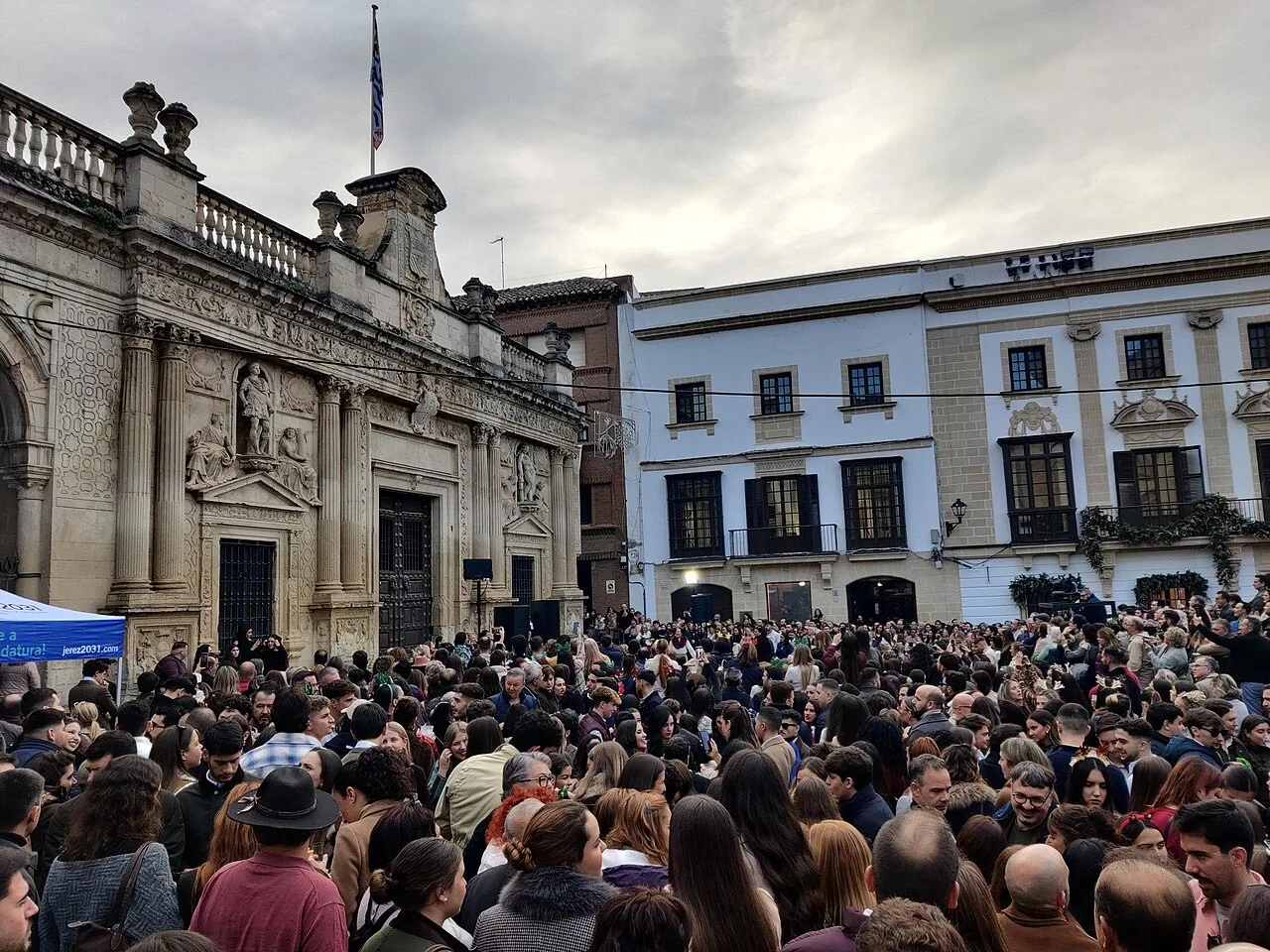
Today the zambomba is one of Jerez's great attractions. According to the municipal report for the December 2024 long weekend, in those five days there were 138 authorized zambombas and some 100,000 people in the street. Hotel occupancy reached 96.07 % on December 6 and 96.80 % on the 7th, and 1,221,682 kilos of waste were collected, 2 % more than the previous year. Of the visitors attended at the tourism points, 44 % came from the rest of Andalucía, 15 % from Madrid and 15 % from abroad.
Success has its other side. Already in 2015 the decree spoke of a "progressive commercialization" of the festival and of an audience that watches instead of singing. The City Council announced in December 2024 an ordinance on zambombas to "protect the essence" of the festival and guarantee coexistence, and opened a public consultation that was open until February 26, 2025.
Each year's proclamation tries to organize the season: zambombas in the street are only for non-profit entities and without amplification, each entity can hold at most two, and bars may celebrate the "traditional" ones without a permit, a cappella or with traditional instruments, without a stage or loudspeakers.
An award for the candle
Since 2025 the City Council and Ecovidrio have held a contest with two prizes of 1,500 euros, one for the most traditional zambomba and another for the most sustainable, which are donated to a social cause. The scoring system rates what makes a zambomba a zambomba: the typical instruments (zambomba, panderetas, almirez, palmas), "gatherings around the fire" and the festival returning to the neighborhoods. This year the contest is repeated.
At the tenth-anniversary Zambomba BIC, last December, the mayor María José García-Pelayo summed it up this way, according to the City Council's statement: "There is only one zambomba that is authentic, also the one in Arcos; the others are copies."
Beyond Jerez
The copies, in any case, number in the hundreds. There are zambombas in all eight Andalusian provinces, in Ceuta and in Melilla, and Jerez Christmas carol shows on tour across half of Spain. In the CádizYa calendar alone there are already more than seventy in the province.
All those in the city, with the dates from the proclamation, the Villamarta and the brotherhoods, are in the special on the zambombas of Jerez. Those in the province, day by day, in the special Zambombas 2026.
Shall we let you know what matters?