Eight deputies and not nine: this is how CádizYa counts the 29-N polls in the province
Cádiz loses a seat on 29-N and the CádizYa special takes it into account: it gathers all the polls, averages them and distributes the province's 8 deputies. We explain its sections, what they say today and how to follow it.
Redacción
·
Photo: CádizYa
Cádiz will elect 8 deputies on November 29, one fewer than in 2023, due to the population adjustment in Royal Decree 806/2026. Not all polls have taken this into account: some still distribute 9, and in our special it appears with a note. The CádizYa general election special has a section that gathers all the polls and converts them into seats with the correct number.
This guide goes through the section and explains each figure.
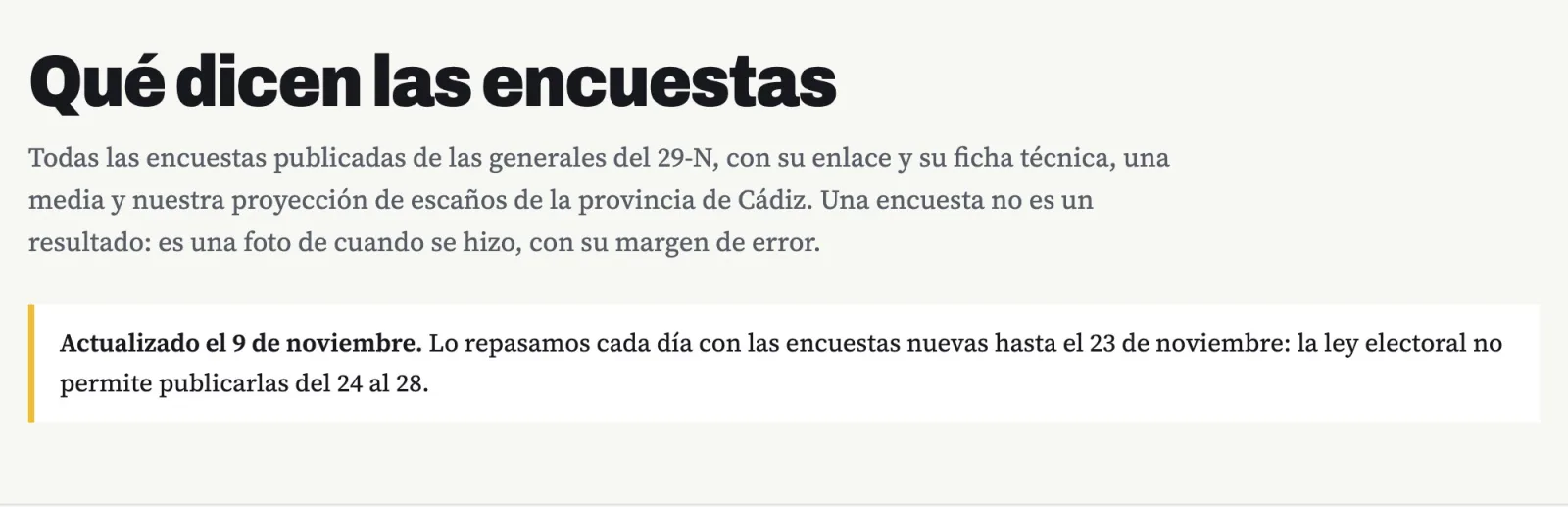
The start of the section, with the date of the last revision. Photo: CádizYa
The parts of the section
It is best to read it in order, because each block explains the next one:
—At the top, the date of the last revision, so you know if what you see is from today.
—The projection for the province of Cádiz, in coloured bars with each party's logo.
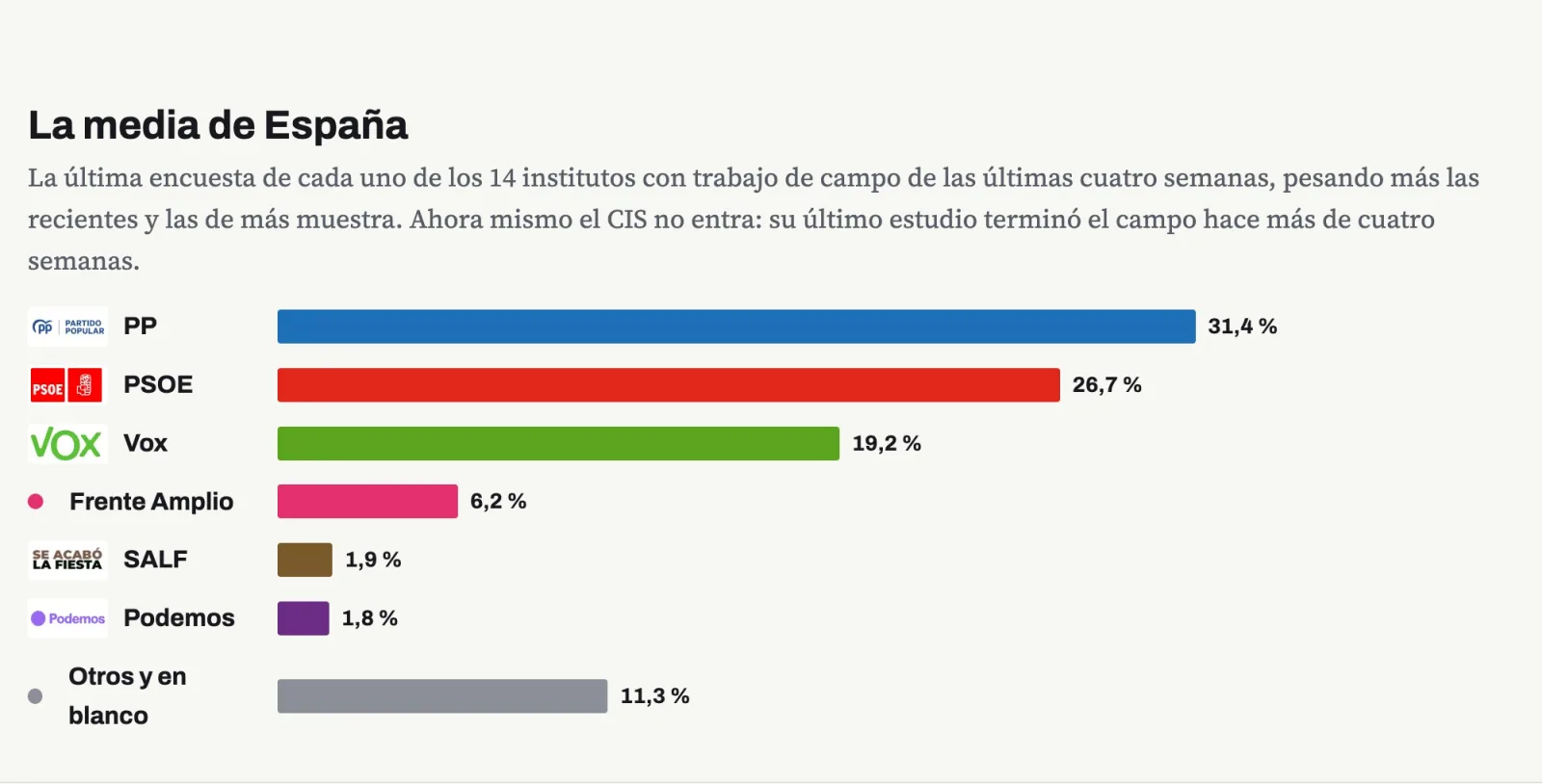
—The average of the polls for all of Spain, from which everything else comes.
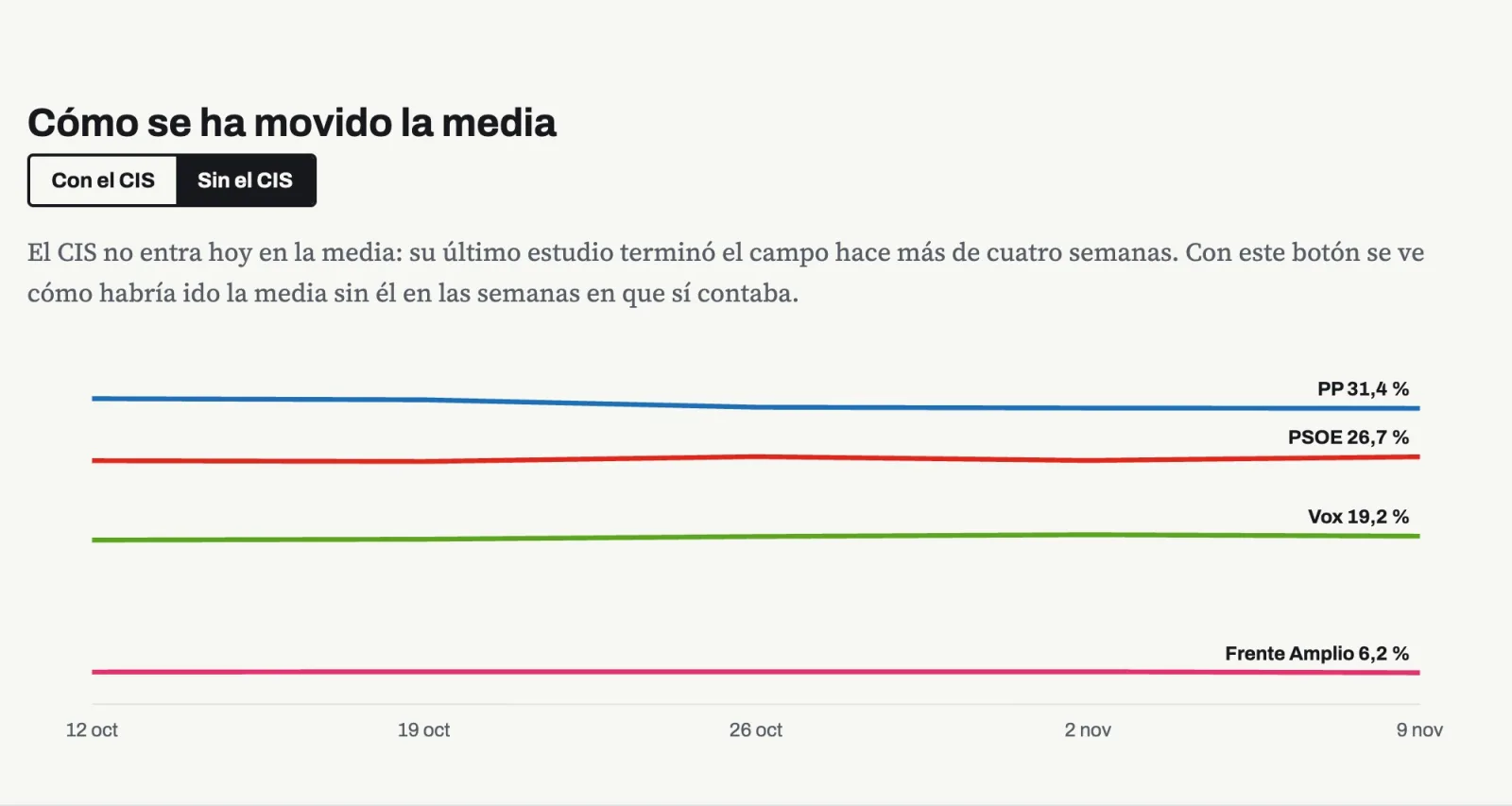
—The evolution of that average since October 12, with the CIS switch.
—What the institutes publish. The polls that give seats for Andalusia or for each province, untouched, so you can compare them with ours.
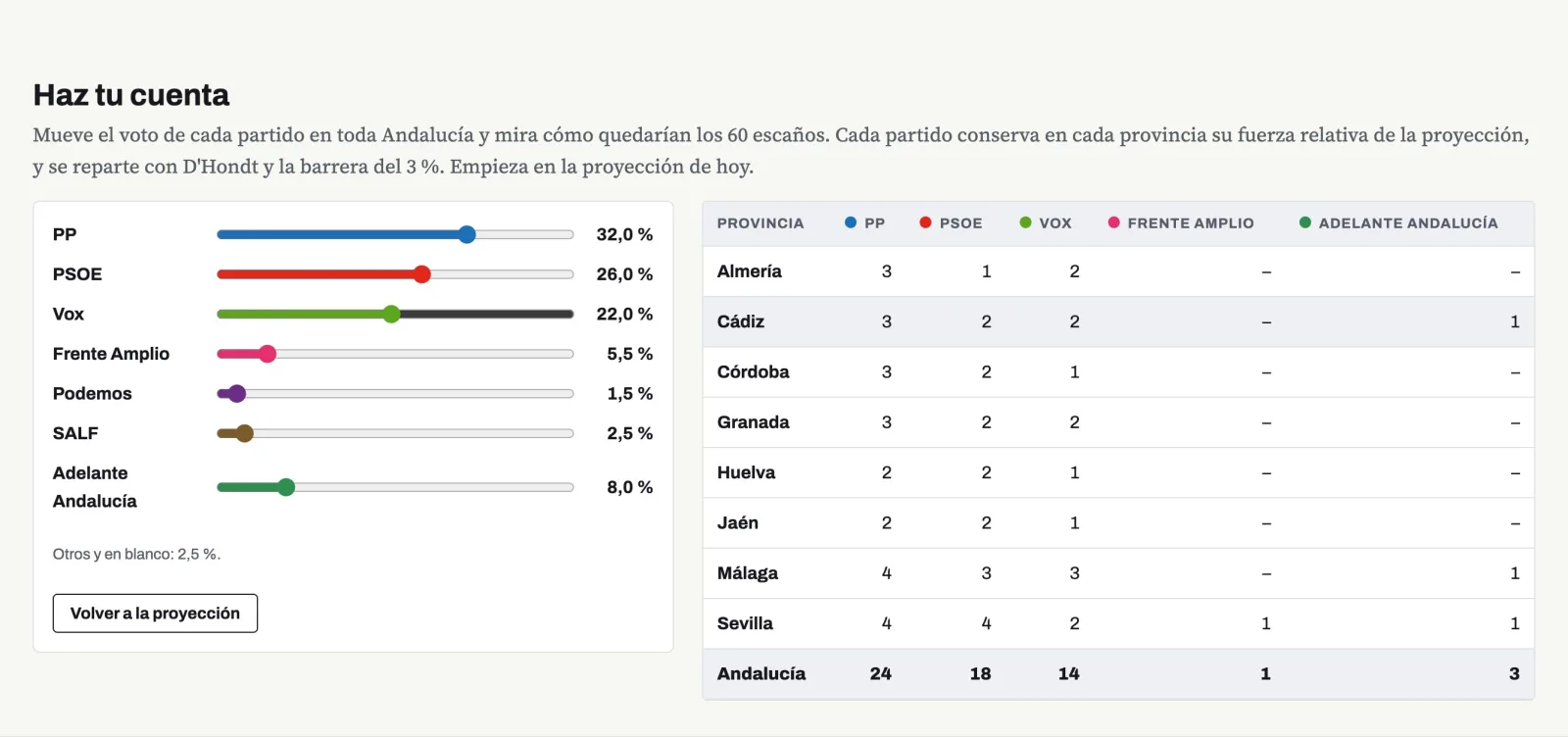
—Do your own count. A simulator with a control for each party: you raise or lower its vote in Andalusia and instantly see how the 60 seats would look, province by province.
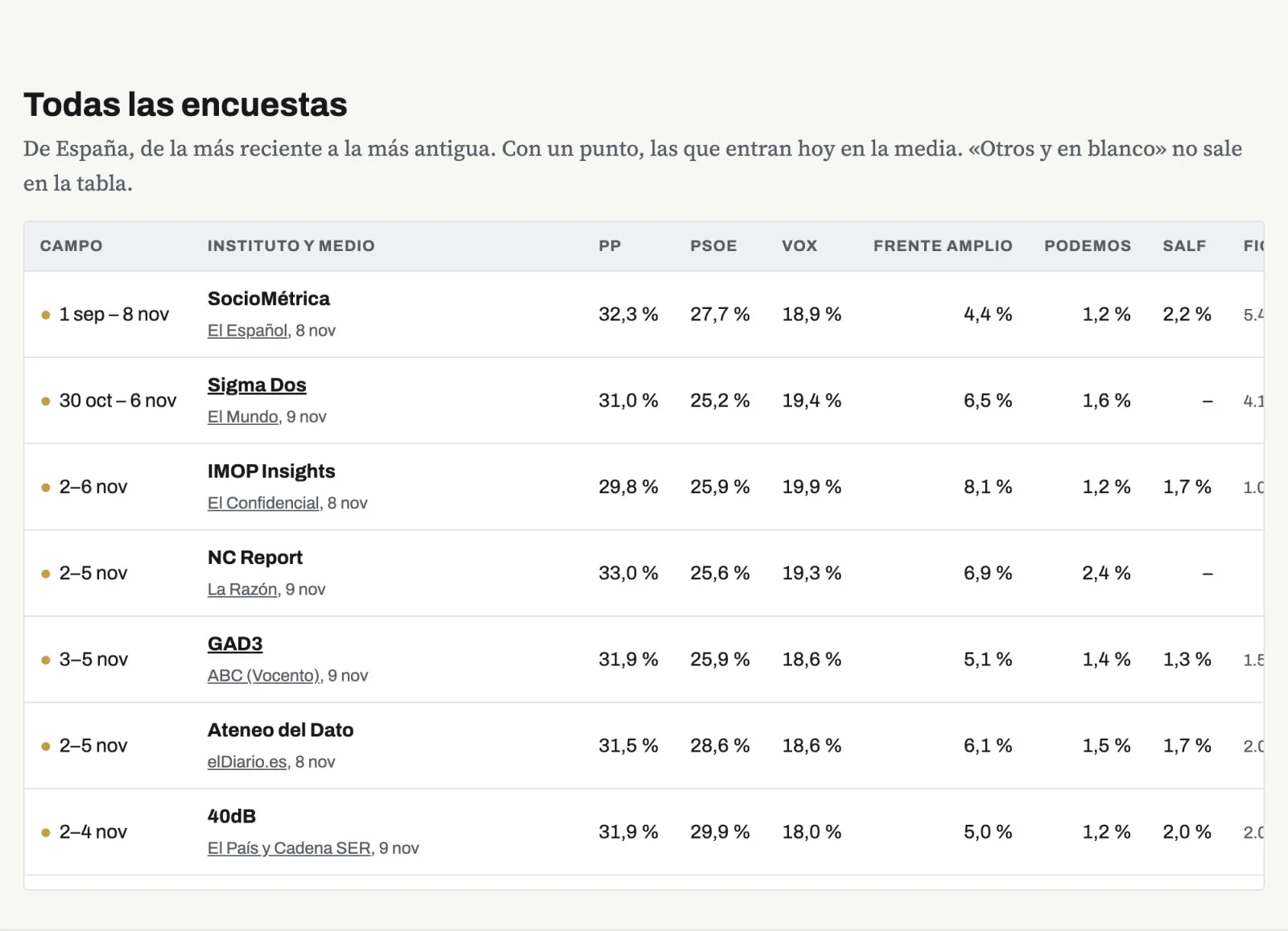
—The table with each published poll, with its link to the original. A dot marks the ones that count today.
—And, folded at the end, the method explained step by step.
What it says today for Cádiz
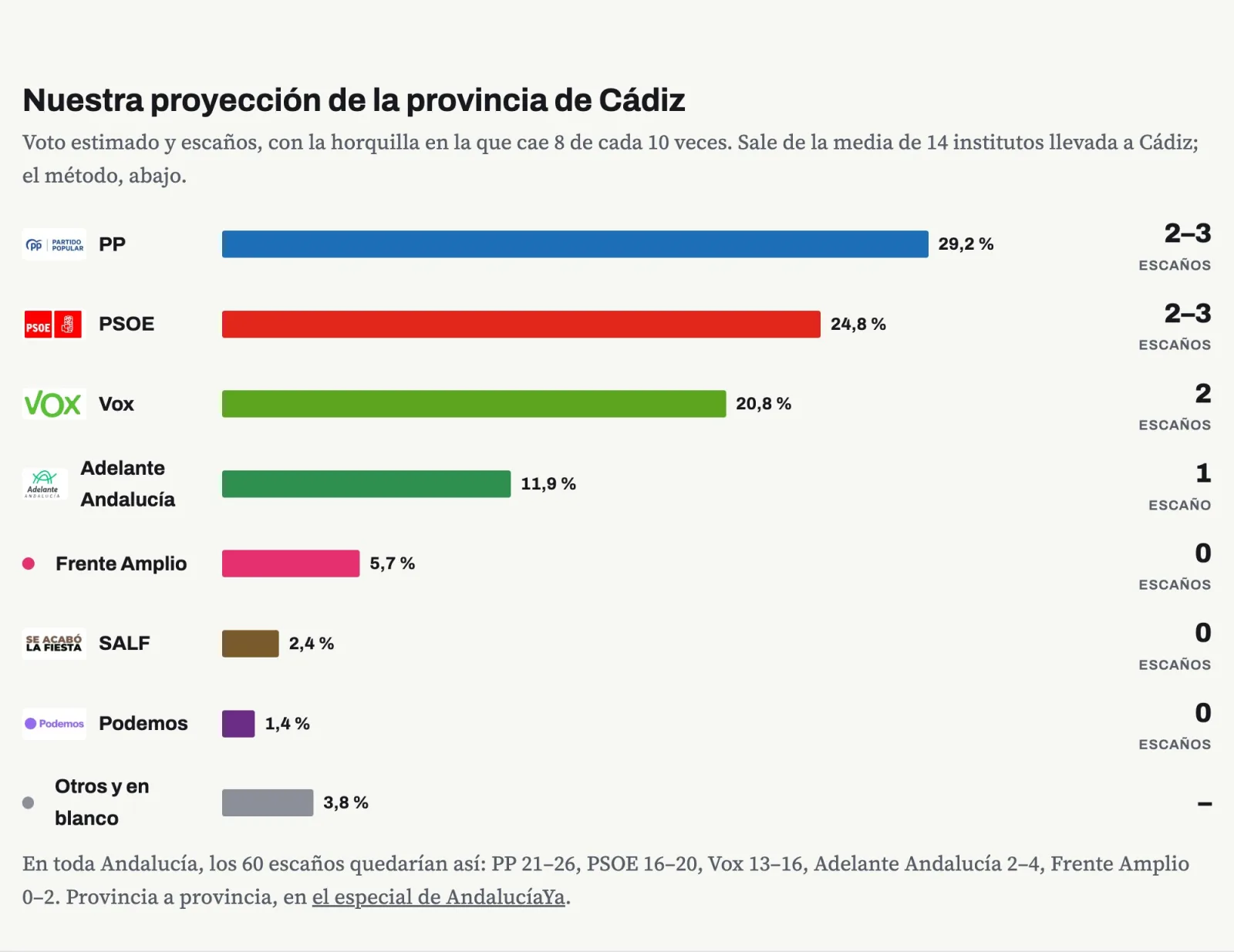
This is how the projection for the province of Cádiz looks in the special, with figures from November 9. Photo: CádizYa
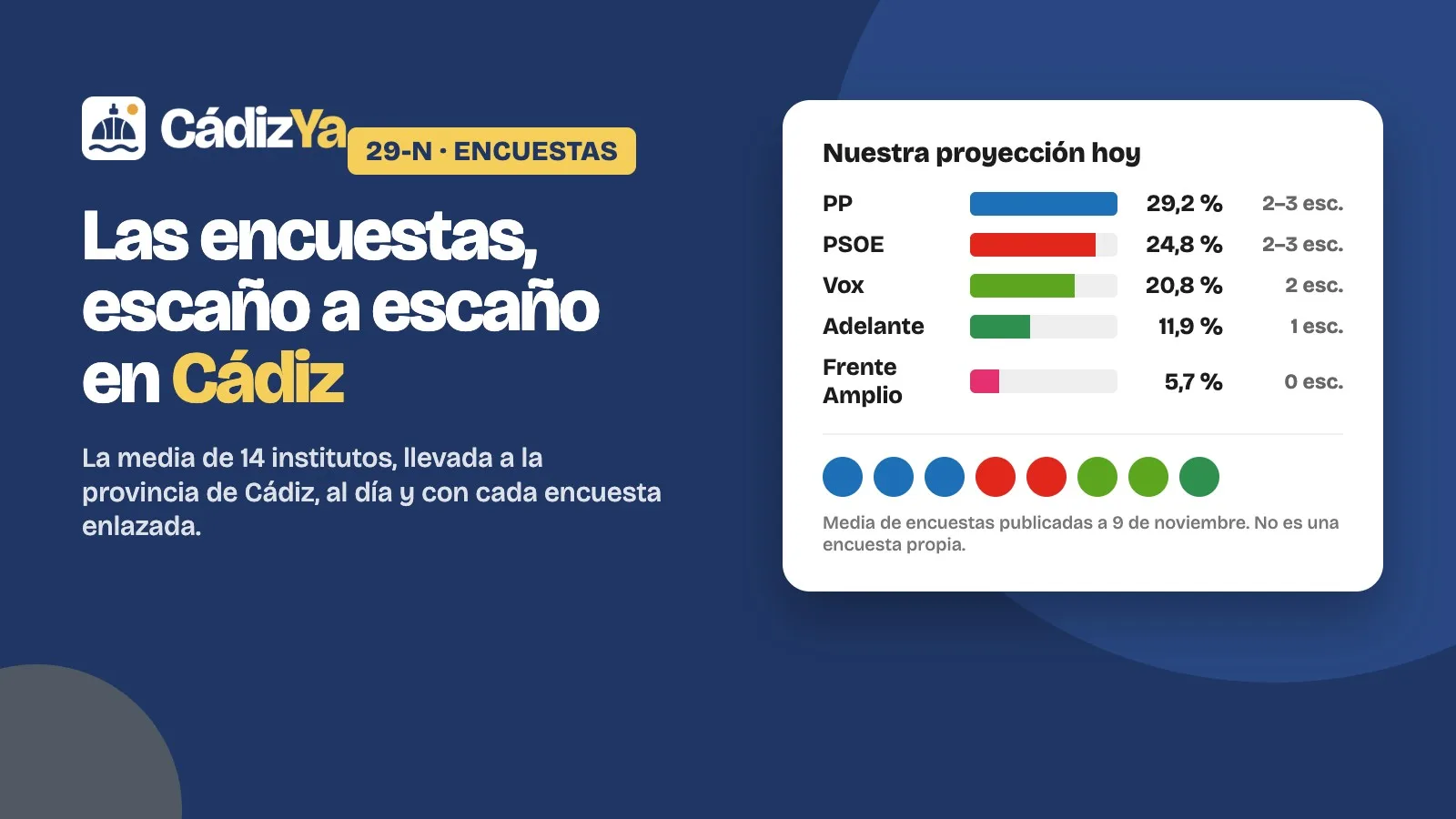
As of November 9, the PP would be the most voted in the province with 29.2% and 3 seats (range of 2 to 3), one fewer than the 4 in 2023. The PSOE, with 24.8%, would have 2, and Vox, with 20.8%, also 2.
The big novelty is Adelante Andalucía: with 11.9%, Cádiz is, along with Sevilla, where it is strongest, and the projection gives it a deputy in 8 out of every 10 repetitions of the range. The seat that was Sumar's in 2023 would today have no owner in Frente Amplio (5.7%).
From 2023 to today's projection
Partido
Votos en 2023
Escaños en 2023
Proyección hoy
Escaños hoy (horquilla)
PP
34,8 %
4
29,2 %
3 (2 a 3)
PSOE
33,2 %
3
24,8 %
2 (2 a 3)
Vox
15,2 %
1
20,8 %
2 (2)
Adelante Andalucía
1,4 %
0
11,9 %
1 (1)
Frente Amplio (Sumar en 2023)
12,9 %
1
5,7 %
0 (0)
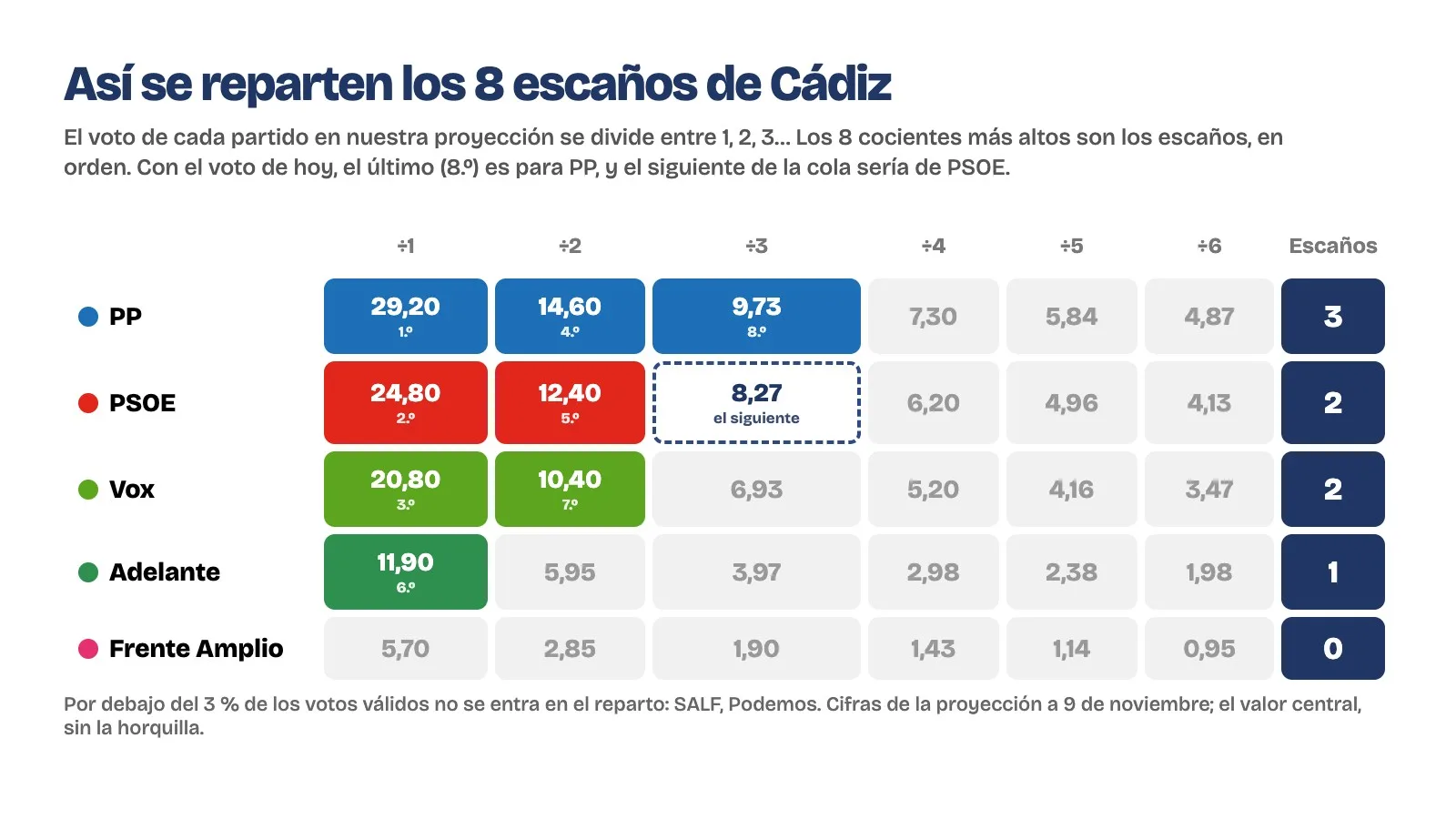
Successive divisions: this is how each deputy is assigned. Photo: CádizYa
To distribute the 8 seats a calculator is enough: divide each party's vote by 1, 2, 3 and so on, and order all the results. The first 8 are deputies. The one that closes the list in Cádiz is from the PP, with 9.73; the first one left out is from the PSOE, with 8.27. With a 1.47-point difference, it is a seat in dispute.
What is behind each number
Four steps and none of them secret. Photo: CádizYa
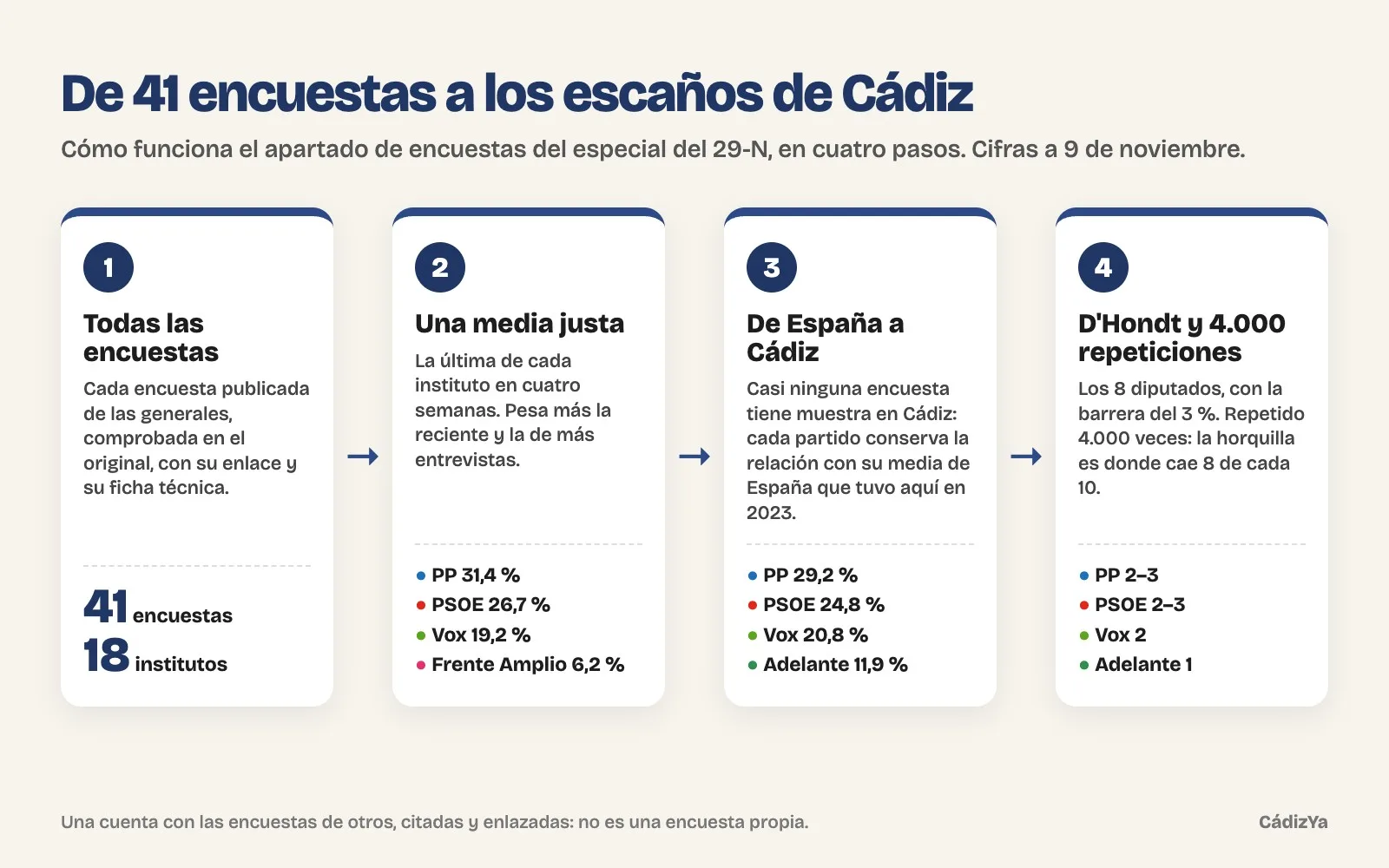
Behind each bar there is a calculation that can be repeated with pencil and paper, and that is explained on the page itself. It starts with the 41 polls published since October 1, from 18 different institutes. Of these, the latest from each institute is kept if it is less than four weeks old, and they are averaged giving more weight to recent ones and to large samples: today there are 14.
The jump to Cádiz is the delicate part. To avoid relying on the few interviews there are in Cádiz, we take how each party behaved here compared with all of Spain in the 2023 general election. In those elections the PSOE had 33.2% here (31.7% in Spain), the PP 34.8% (33.1%) and Vox 15.2% (12.4%). That relationship is transferred to today's average and, in the end, everything is readjusted to add up to 100. With two exceptions: Podemos and SALF take the 2024 European elections as their base, and Adelante Andalucía the Andalusian elections in May.
And the last step: the distribution of the 8 seats is done with D'Hondt and the 3% threshold. Since no average is exact, we repeat the calculation 4,000 times with random errors similar to real ones: the result falls within the range in 8 out of every 10.
The projection for the province of Cádiz comes from this average. Photo: CádizYa
Two averages: with and without the CIS
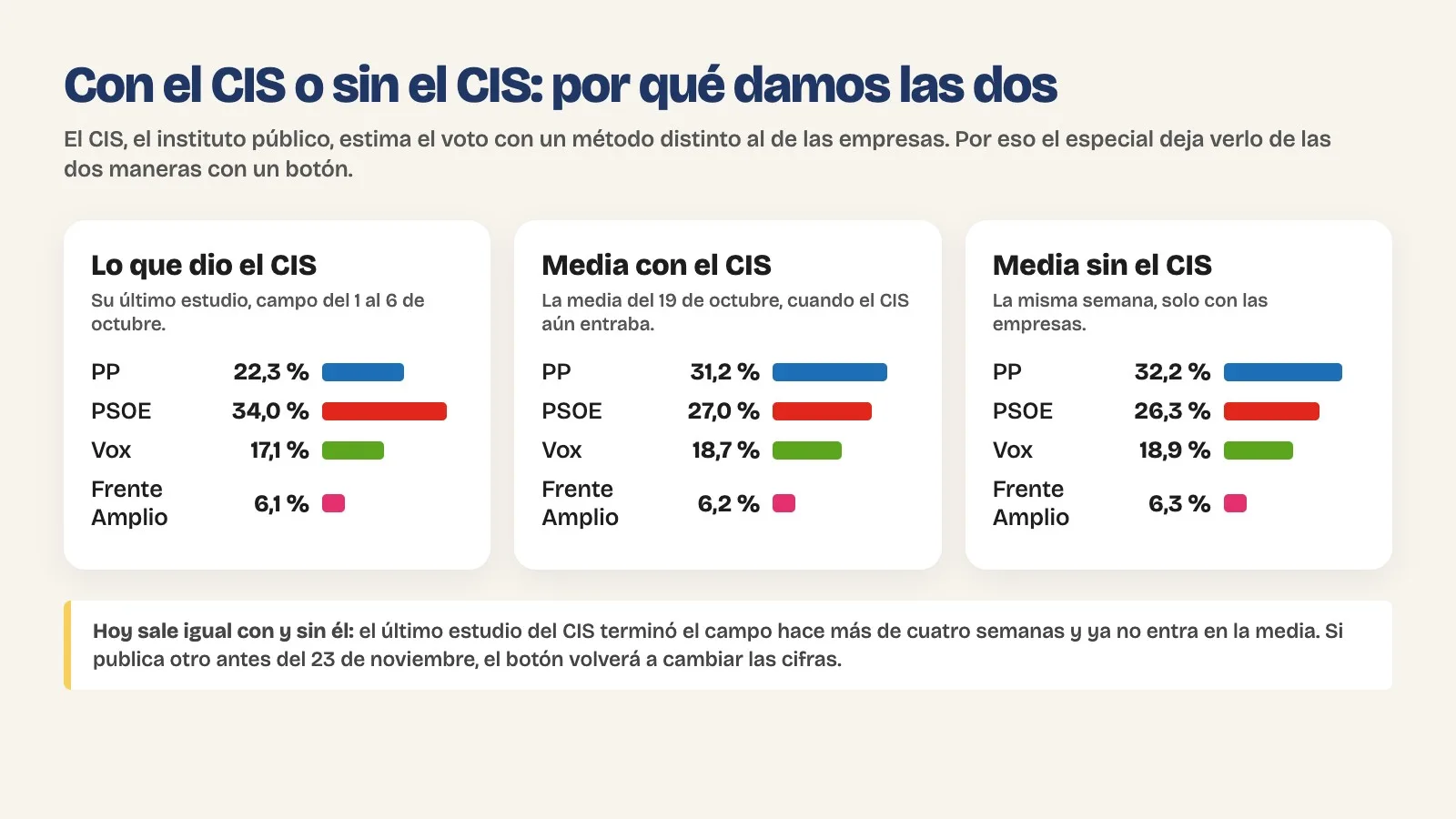
The CIS versus the average, with and without it. Photo: CádizYa
"With the CIS" and "Without the CIS" are the two ways of seeing the average offered by the special. The reason is simple: the CIS estimates with its own method and usually gives results very different from those of private companies. In its October study (fieldwork from 1 to 6), the PSOE came out with 34.0% and the PP with 22.3%.
That study was included in the average while it was less than four weeks old. In those days the button changed the figures: on October 19, the PP had 31.2% with the CIS and 32.2% without it. Now it has expired for the average, so today's projection does not depend on it. The button remains on the chart, to see how the average would have gone without the CIS in those weeks. If it publishes a new study before the November 23 cut-off, it will count again.
The average chart in the CádizYa special, with the CIS switch. Photo: CádizYa
Do your own count
The CádizYa special's simulator, at its starting point. Photo: CádizYa
In the simulator you can see why Adelante Andalucía is key in Cádiz: lower its vote in Andalusia to 5% and see what happens to its Cádiz seat. You can also try the opposite and see where the second one would win.
In "What the institutes publish" you will see the Sigma Dos poll for El Mundo (fieldwork up to October 14) with a warning: it distributed 9 deputies in Cádiz, those of 2023, and not the 8 of this year. It gave PP 5, PSOE 2 or 3, Vox 2 and Adelante 0 or 1. That is why each poll should be read in context.
All the polls, with their link
The table of all the polls: a dot marks the ones that count today. Photo: CádizYa
All of the above rests on the table at the end: each published poll, with its link, its fieldwork date and its technical details. None is discarded for its result; it only stops counting when it is more than four weeks old or when its institute publishes another.
How to follow it day by day
Every morning we check whether there are new polls, we verify them against the original, we add them and the page rebuilds itself. To make the most of it:
—Go to the polls section and first look at the "Updated" date: it tells you when what you see is from.
—Compare with the previous week in the average chart: a rise of one tenth is not news; a trend over several weeks is.
—Pay attention to the range rather than the central number. If a seat is "in the air", the range says so.
—In the table of all polls, the dot marks the ones that count today. If you want to know who carried out one, click on its name and you go to the original.
—From November 24 to 28 the law does not allow polls to be published: the section will keep the data from the 23rd and a notice.