
Planting trees where there was no forest increases fires by 26%
Topics Universidad de Cádiz
A study led by researchers from the University of Cádiz indicates that afforestation in non-forest areas increases fire activity in temperate regions.
CádizYa newsroom ·
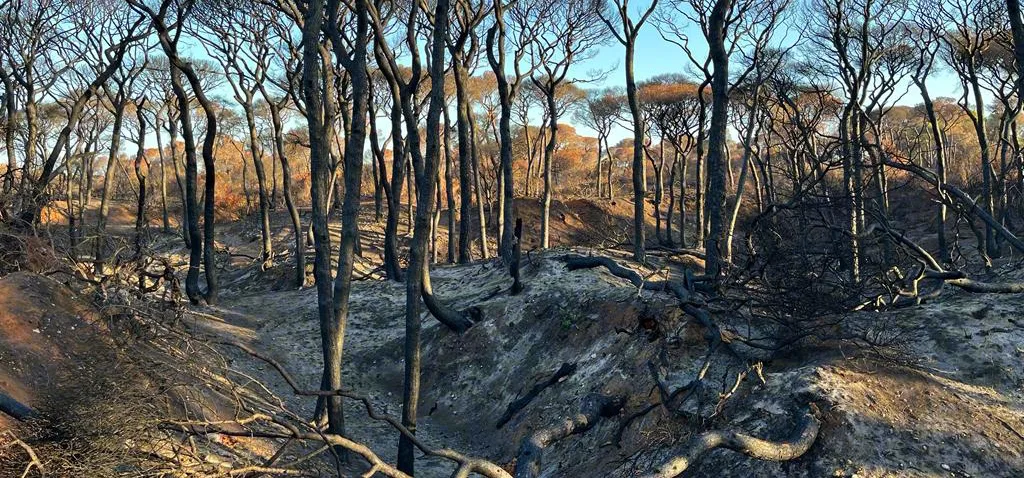
Converting land that never was forest into forest can sharply increase fire risk. An international study led by researchers from the University of Cádiz has found that this practice, known as afforestation, is associated with a 26% increase in fire occurrence and a 23% increase in burned area across the temperate regions analyzed, according to the academic institution.
The work is published in the scientific journal Proceedings of the National Academy of Sciences (PNAS) and is titled Afforestation reshapes wildfire activity across global temperate biomes. It is signed by Irene Repeto-Deudero and Susana Gómez-González, linked to the Department of Biology and the Institute of Viticulture and Agri-Food Research (IVAGRO) of the University of Cádiz, together with Juli G. Pausas, a researcher at the Spanish National Research Council (CSIC) at the Center for Research on Desertification (CIDE), and other specialists from Chile and Finland.
The research analyzed 67,248 temperate biome areas of the planet transformed into forest plantations between 2001 and 2023. Satellite data and statistical models were used to compare fire activity before and after the plantations were created, discounting climatic and human factors.
The Mediterranean case
The effects are not the same in all ecosystems. In temperate coniferous forests, fire occurrence multiplied by 2.7 and burned area nearly doubled. In Mediterranean ecosystems, fire frequency rose 38% and burned area 9%. That figure matters in territories such as southern Europe, where summer droughts, high temperatures and flammable vegetation make it easier for fire to spread: new forest masses can increase the amount and continuity of plant fuel.
In temperate broadleaf and mixed forests, afforestation reduced fire occurrence by 23%, but increased burned area by 20%. That is, there are fewer fires, but when they appear they affect more land. Almost half of the world's forest plantations are in this type of ecosystem. In temperate grasslands, savannas and shrublands it was the only biome where afforestation was linked to an 18% drop in fire occurrence, without a significant increase in burned area.
Given these differences, the authors consider it necessary to assess the characteristics of each ecosystem before promoting large-scale afforestation programs. They note that climate mitigation policies based on planting trees must incorporate an assessment of fire risk and of the conditions of the territory where action is intended. This is not, they explain, about questioning the importance of forests or their conservation, but about recognizing that planting trees anywhere is not necessarily a solution to climate change.
Breaking news from News, on your phone
An alert only when something can't wait. Free, no account needed.
On iPhone, alerts only arrive if you first add CádizYa to your Home Screen. How to do it, step by step
This browser can't receive alerts. Try another one, such as Chrome or Safari.
You've blocked alerts from CádizYa in this browser. You can turn them back on in its settings. How to do it, step by step
Only what can't wait. Change or remove it in my alerts
Shall we let you know what matters?
Phone alerts
On iPhone, alerts only arrive if you first add CádizYa to your Home Screen. How to do it, step by step
This browser can't receive alerts. Try another one, such as Chrome or Safari.
You've blocked alerts from CádizYa in this browser. You can turn them back on in its settings. How to do it, step by step